Brazil Election 2026: Why Trump Is Accused Of Interference
Brazil votes on 4 October, but the contest between Luiz Inácio Lula da Silva and Flávio Bolsonaro is unfolding under an extraordinary allegation: that the United States is trying to shape Brazil’s political direction.


Abin’s Critical Warning On US Pressure
This is no longer only Lula’s accusation. Brazil’s intelligence agency, Abin, rated escalating US pressure on the election as “critical.” It then briefed French and German officials and, according to the meeting report, confirmed interference from the United States as well as Russia. Abin officials described the alleged US interference as ranging “from lawfare to interference that is openly acknowledged.”
Brazil’s cyber defences are under strain too. A senior Brazilian cyber official said cyberattacks had nearly doubled compared with 2025, with election-related hacking and phishing aimed at the president’s office. Nobody has publicly said who is behind them.
Washington has previously denied trying to interfere. The White House calls the claims “nonsense.”
Tariffs, Sanctions And The Bolsonaro Coup Case
To understand the fight, start with Flávio’s father. Former president Jair Bolsonaro was convicted of plotting a coup and sentenced to 27 years.
Washington answered with concrete measures. Trump’s administration imposed tariffs on Brazilian goods while openly criticising the prosecution. Supreme Court Justice Alexandre de Moraes, who oversaw the case, faced US visa restrictions and sanctions that were later lifted.
Lula’s campaign now alleges that these tariffs, sanctions and visa measures form part of a wider attempt to influence the election. Its complaint also points to the Rockbridge Network, a conservative US donor group co-founded by JD Vance, saying an organiser tied to it works at Flávio’s São Paulo headquarters, and to paid pro-Bolsonaro posts from accounts outside Brazil.
Those allegations are serious, but they remain allegations rather than court findings.
Flávio Bolsonaro, The White House And The Tariff Delay
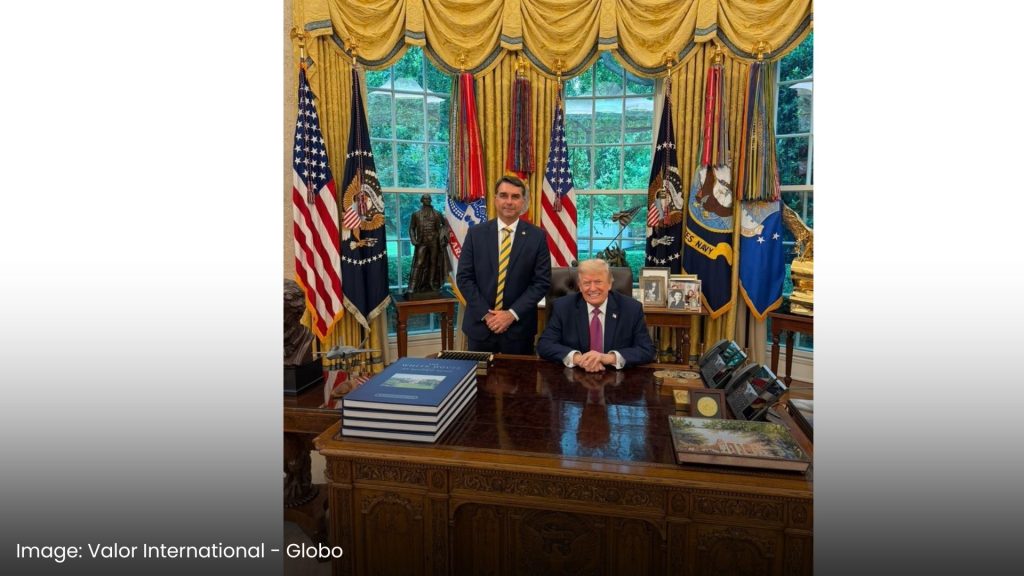
Then there is Flávio himself. He met Trump, Rubio and Vance at the White House in May. Weeks later, he asked Washington to delay tariffs for 180 days, noting that Brazil’s political landscape would be “redefined within roughly ninety days.” Lula called it “yet another act of treason against the Fatherland.”
The pressure may have backfired. Lula’s approval rose above 50% after the July tariffs.

Why Brazil Matters To Washington And Beijing
This is where the story becomes much bigger than one political family.
Brazil is a major BRICS power. China is its largest trading partner, with trade reaching a record $171 billion in 2025. The country also holds critical minerals increasingly important to technology, energy and defence.
According to Brazilian reporting, Abin assessed that Washington seeks to strengthen its influence across Latin America while limiting rival powers’ access to strategic assets and natural resources, with China central to that concern.
That does not prove China, BRICS or Brazil’s resources caused specific American actions. It does explain why Brazil’s direction matters so much to both Washington and Beijing.
Why The Venezuela Comparison?
For critics, Venezuela provides the warning: sanctions, economic pressure and political confrontation can turn a domestic struggle into an international geopolitical battle. Brazilian reporting has noted that Venezuela is already appearing in the country’s political debate. But the comparison has limits.
There is no verified evidence that the United States has manipulated Brazilian ballots, voting machines or the vote count. The question is whether pressure, sanctions and political relationships amount to influencing the environment in which Brazilians vote.
Concern has reached Washington too. Bernie Sanders and 30 House Democrats raised alarm about apparent attempts to interfere. Three Democratic senators then accused the administration of a campaign of interference and destabilisation.


US Embassy Closure Days Before Brazil Votes
Then came the closures. The US suspended consular services and Australia closed its embassy in Brasília, both citing security. Brazil’s federal police found “no evidence corroborating the initially reported threat.” Lula’s Workers’ Party called the move “unprecedented.”
Tomorrow, Brazilians Decide
The race is close to a coin toss. One poll put a runoff at 47.7% for Flávio and 47.6% for Lula. If nobody passes 50% tomorrow, the two meet again on 25 October.
Whoever wins, foreign influence is now part of the election itself. The decision belongs to Brazilian voters.
By Shizza Umer
Sources
Reuters
Reuters
Folha de S.Paulo
Folha de S.Paulo
Folha de S.Paulo
Folha de S.Paulo
Folha de S.Paulo
Al Jazeera
Al Jazeera
Al Jazeera
Time
Axios
Courthouse News
Responsible Statecraft
South China Morning Post